A large Kakobuy spreadsheet can save time during product discovery, but only if you know what to check before moving from a promising listing to an external ordering platform. A title, product photo and listed price are useful starting points; they are not enough to evaluate fit, construction, available information or the likely shipping implications. This checklist turns the browsing process into a series of practical checkpoints, so you can compare Kakobuy finds consistently instead of making decisions from the first attractive result.
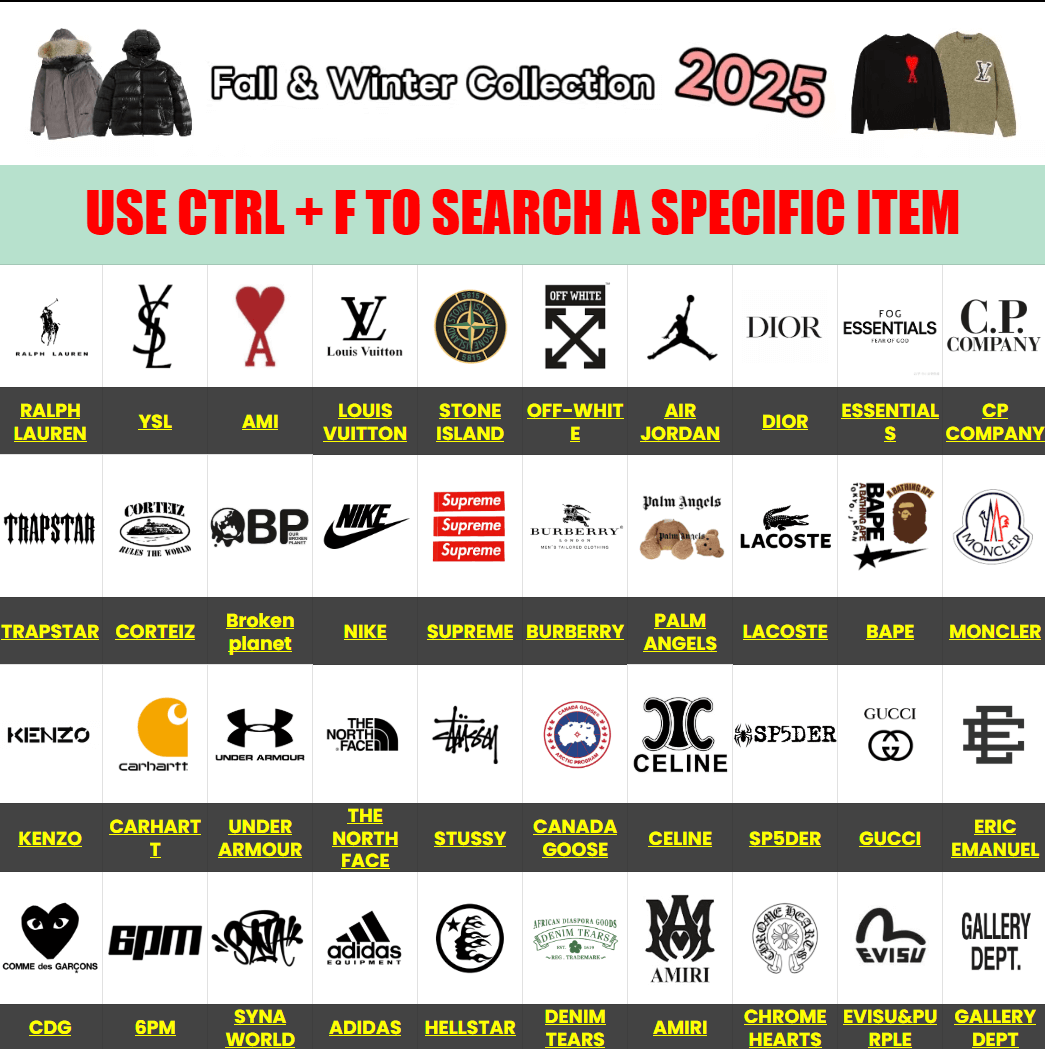
Smart Search Tip: Looking for more? To find items instantly, use single-word keywords (e.g., “SHOES” or “T-SHIRT”) instead of long sentences for the best results.
Start With the Search, Not the Purchase Decision
The first mistake with a large sourcing directory is treating search as if it were already selection. A product spreadsheet may contain many entries that look similar, and browsing them one by one can quickly become inefficient. The better approach is to define what you are looking for first, then narrow the available choices.
If you already know the category, use it. If you know the product type, search with a short keyword. The purpose is to reduce noise before you spend time reviewing photographs, measurements and other details. The web-based Kakobuy spreadsheet 2026 catalog is particularly useful at this discovery stage because category and product navigation can be faster than working through a long traditional spreadsheet.
Before opening individual entries, establish three simple criteria:
- What type of product do you actually need?
- Which specifications affect the decision?
- Which information would make you reject a listing?
For example, someone searching for an everyday jacket may care about garment measurements, construction, visible hardware and overall weight. A footwear search may place more emphasis on foot length, insole length, sole construction and visible shape. The checklist should follow the product rather than forcing every category through the same evaluation process.
The Listing Information Check
Once you find a promising entry, resist the temptation to make a decision immediately. First establish what the listing actually tells you.
Look at the product name, available variants, measurements, dimensions, stated materials where supplied, photographs, seller-provided information and the current product link. Then separate confirmed information from assumptions.
| Checkpoint | What to Look For | Why It Matters |
|---|---|---|
| Product identity | Name, images and current listing details | Confirms that you are evaluating the intended item |
| Variants | Colour, size, configuration or other options | Different variants may not have identical details |
| Measurements | Seller-provided dimensions or sizing information | Provides a more useful reference than a generic size label |
| QC material | Available photographs from different angles | Allows closer inspection of visible details |
| Availability | Current listing status | Community information may become outdated |
A community listing should not automatically be interpreted as independent verification. Its presence in a directory does not establish product quality, authenticity, seller reliability or successful delivery. The listing is a research input. The more important question is whether it provides enough current information for your particular decision.
Watch for incomplete information
An incomplete listing is not necessarily unusable. It simply requires a different level of caution. If measurements are missing, do not estimate them from the product photograph. If the material is not clearly stated, do not infer its composition from appearance. If availability is unclear, check the current listing before proceeding.
This habit is useful because it prevents a common form of sourcing error: turning visual impressions into facts without enough evidence.
Compare the Details That Actually Matter
Finding one interesting product is easy. Deciding whether it is the most suitable option requires comparison.
Rather than opening ten listings and trying to remember everything, compare a small group using the same criteria. Price is one field, but it should sit alongside the specifications that define the product’s usefulness.
For clothing, useful comparison points can include chest width, garment length, shoulder width, sleeve length, waist and hip measurements where relevant. For shoes, foot length, insole length and visible sole construction can be more useful than a familiar size label. For accessories, product dimensions and weight may be more important than nominal sizing.
The comparison should also account for information quality. If one listing provides detailed measurements and several useful photographs while another provides only a title and one image, they do not offer the same amount of information for decision-making.
Use a shortlist instead of a giant comparison
A practical shortlist might contain three to five entries. For each one, note the information that could change your decision:
- Listed price or other displayed cost information
- Relevant dimensions
- Available colour or configuration
- QC photographs or other supporting images
- Visible construction details
- Product weight if provided
- Information that remains unclear
The last point is easy to overlook. Missing information can be a meaningful part of the comparison because it tells you what still needs verification before ordering.
Use QC Photos as Evidence, Not Proof
QC photographs are most useful when you approach them as a visual inspection rather than a quality certificate. They can reveal details that are difficult to understand from a catalogue image, particularly when several angles are available.
For clothing, inspect stitching, panel alignment, graphics, labels, hardware, overall shape and visible defects. On jackets, pay particular attention to zippers, pockets, seams, cuffs and the way the garment sits in the photographs. On footwear, check the visible upper, sole construction, symmetry, stitching and obvious surface issues.
Look at the photographs systematically rather than simply asking whether the product “looks good.” A useful inspection sequence is:
- Check the overall shape and structure.
- Inspect stitching and major seams.
- Examine logos, graphics or printed elements for visible alignment.
- Check hardware such as zippers, buttons or buckles.
- Look for obvious marks, damage, loose threads or other visible defects.
- Compare different angles for consistency.
There are also clear limits. Photographs cannot conclusively establish fabric composition, long-term durability, chemical composition, authenticity, long-term comfort or performance after extended use. A photograph can show a visible characteristic; it cannot answer every question about the underlying product.
That distinction becomes especially important when several listings use similar promotional imagery. Focus on the photographs and information actually associated with the entry you are reviewing rather than assuming that details from one listing apply to another.
Check Measurements Before Choosing a Size
Size labels are convenient but unreliable as a universal comparison tool. S, M, L and XL can represent different measurements between manufacturers, product types and production batches. For international shoppers, this matters even more because familiar retail sizing may not translate directly to another sizing system.
The safer approach is to compare actual dimensions with a garment, pair of shoes or accessory you already know fits or works for your needs.
For apparel, check the measurements that correspond to the product’s construction. Chest width, garment length, shoulder width and sleeve length are common reference points. For trousers or similar products, waist, hip and leg-related measurements may matter more. For footwear, compare your foot length and the available insole measurement when supplied.
Do not assume that a photograph can substitute for a missing measurement. The apparent proportions of a garment can be affected by camera angle, posture and how the item is positioned.
Product specifications deserve the same attention as price
Suppose two jackets have similar prices. One provides a complete set of garment measurements while the other gives only a general size range. If fit is important, the difference in information itself is worth noting. It does not prove that one product will fit better, but it gives you a more concrete basis for evaluation.
The same principle applies to dimensions and weight. A larger product may occupy more space in the eventual parcel, while a heavier construction may affect shipping considerations. These factors become relevant after the product has already passed the basic fit and specification checks.
Add Shipping to the Value Calculation
A product’s displayed price does not necessarily represent its complete cost to an international shopper. Shipping method, destination, parcel weight and dimensions can all affect the eventual amount.
Product weight is useful for planning, but it should not automatically be treated as the final shipping weight. Packaging can add mass, and some services may calculate charges using volumetric weight when the parcel occupies significant space relative to its actual mass.
| Shipping Question | What to Verify |
|---|---|
| What is the product weight? | Check whether a current weight figure is actually provided |
| How large is the item? | Consider whether dimensions could affect volumetric calculations |
| What is the final parcel weight? | Use the prepared shipment information when available |
| Which shipping service applies? | Check the current options available for the destination |
| Are local taxes or customs relevant? | Check current destination-specific requirements |
For shoppers in the US, Canada, UK, EU, Australia and New Zealand, shipping and import treatment can differ. VAT, GST, customs procedures and arrangements such as IOSS or DDP/DDU may be relevant depending on the transaction and destination. There is no universal rule that should be applied to every order.
For international purchases, the safer workflow is to check current platform information and applicable customs guidance for your country before dispatch. Do not rely on an old spreadsheet entry for current shipping prices, tax thresholds or delivery estimates.
Shipping should also be considered when building a multi-item order. Adding several inexpensive products may appear attractive individually, but additional weight or parcel volume can change the economics of the shipment. The useful comparison is therefore the overall order rather than the catalogue price of each item in isolation.
The Pre-Order Checklist
After narrowing your shortlist, run one final pass. This is where discovery information becomes a more structured purchase check.
- Product: Is this definitely the listing and variant you intended to review?
- Price: Have you checked the current displayed price rather than relying on an old reference?
- Measurements: Have you compared actual dimensions instead of relying only on the size label?
- QC: Have you inspected all useful photographs for visible construction details and defects?
- Specifications: Are the important product characteristics clearly stated?
- Unknowns: Have you identified information that remains unverified?
- Weight: Is the available weight information clearly identified as product or shipment information?
- Shipping: Have you checked the current shipping options for your destination?
- Customs: Do you need to review current local import, VAT/GST or biosecurity requirements?
- Link: Does the external ordering destination correspond to the product you selected?
One useful discipline is to stop when a missing fact is genuinely important. If the decision depends on a measurement that is unavailable, continuing to browse for a lower price does not solve the underlying problem. Find another listing with sufficient information or verify the missing detail through the appropriate current source.
The checklist is also not meant to turn ordinary shopping into an audit. For a low-risk, familiar product, a quick review may be enough. For an expensive, bulky, highly size-sensitive or internationally shipped item, spending more time on measurements, QC photographs and shipping conditions can prevent avoidable surprises.
Frequently Asked Questions
Q: What should I check first in a Kakobuy spreadsheet listing?
A: Start by confirming the product identity, variant and current listing information. Then check the specifications that matter for your intended use before spending time on detailed comparisons.
Q: Are QC photos enough to decide whether a product is suitable?
A: They are useful visual evidence, but they are not a complete verification method. Use them alongside measurements, listing information and other available specifications.
Q: Should I use S, M, L or XL when choosing clothing?
A: Treat the label as a reference rather than a universal measurement. Actual chest, length, shoulder, sleeve, waist or hip dimensions are generally more useful when available.
Q: Does product weight tell me the final shipping cost?
A: No. Product weight can help with planning, but the final calculation may also depend on packaging, parcel dimensions, volumetric weight, destination and the selected shipping service.
Q: How many products should I compare before choosing one?
A: There is no fixed number. A shortlist of several genuinely comparable entries is usually more useful than comparing a very large number without consistent criteria.
Q: What if an important specification is missing?
A: Treat it as unknown rather than estimating it from photographs or similar listings. Check the current product information or choose an entry that provides the measurement or specification you need.
A strong Kakobuy shopping checklist is less about finding a single “best” listing and more about making each decision traceable. Search narrowly, compare relevant specifications, inspect available QC photographs, verify measurements, consider the eventual shipment and identify what remains unknown. That process gives international shoppers a clearer basis for deciding which finds deserve further attention before they move to an external ordering platform.